Soluble fiber dissolves or swells in water and is often fermented by gut microbes, while insoluble fiber adds bulk and keeps its structure as it moves through the digestive tract. Most plant foods contain both in varying amounts, so the useful goal is a varied, fiber-rich diet rather than sorting every food into one category. This page explains the difference and what to check before changing your intake.
The short answer: if stools are hard, soluble fiber such as oats, psyllium or beans is the usual starting point because it holds water. If movement is slow and stools are infrequent, insoluble fiber from whole grains, wheat bran and vegetable skins adds the bulk that helps things along. Most people benefit from both, and the rate you increase matters more than the type you pick.
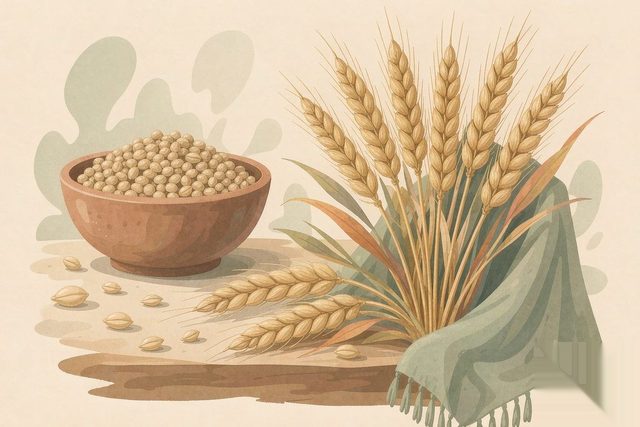
The basic distinction
“Soluble” and “insoluble” describe broad behaviors in water, but foods usually contain a mixture of both. Soluble fibers can dissolve or swell in water and may be fermented by gut microbes. Insoluble fibers add bulk and retain structure as food moves through the digestive tract. The boundary is useful for learning, but it is not a perfect biological classification.
Oats, barley, beans, lentils, fruit, and some vegetables provide soluble fiber along with other nutrients. Whole grains, wheat bran, nuts, seeds, and vegetable skins often contribute more insoluble fiber. The same food can supply both types, and processing changes texture and fiber properties. A varied diet is therefore more informative than trying to assign every food to a single category.
A useful mental shortcut: soluble fiber tends to become a soft gel (think oatmeal thickening as it cooks), while insoluble fiber tends to keep its structure (think the stringy parts of celery). Neither behavior is “better” — they serve complementary roles in how stool forms and moves.
What the trials measured, outcome by outcome
Most comparisons of soluble and insoluble fiber stop at the difference in behavior. That leaves you without the one thing that matters: how large is the effect, on what, and how certain is it. Below is the pooled trial evidence for soluble fiber, split by outcome. Insoluble fiber is included where head-to-head data exists, which is less often than you might expect.
| Outcome | Evidence strength | Measured effect | Pooled from | Caveat |
|---|---|---|---|---|
| Total cholesterol | Moderate | −10.82 mg/dL (95% CI −12.98 to −8.67) | Meta-analysis of RCTs, soluble fiber supplementation | Effect scales with dose, not with food source |
| LDL cholesterol | Moderate | −5.57 mg/dL per 5 g/day added | Dose-response meta-analysis | Strongest in people starting with higher LDL |
| LDL (oat β-glucan specifically) | Moderate | −0.25 mmol/L at ≥3 g/day | Meta-analysis of oat β-glucan RCTs | HDL and triglycerides unchanged |
| Post-meal glucose (type 2 diabetes) | Low to moderate | SMD −0.74 (95% CI −1.00 to −0.48) | Meta-analysis in adults with type 2 diabetes | Substantial heterogeneity between trials |
| Body mass index (type 2 diabetes) | Low | SMD −0.31 (95% CI −0.61 to −0.00) | Same meta-analysis | Confidence interval touches zero |
| Bowel regularity | Low (self-reported) | Direction consistent, magnitude unclear | Observational and small trials | No reliable pooled effect size exists |
Two readings of this table matter more than the numbers themselves.
The cholesterol effect is the best-supported one, and it is modest. A reduction of roughly 11 mg/dL in total cholesterol is real but not dramatic — it is the kind of change a clinician notices alongside other measures, not a substitute for one. The dose-response data is the useful part: each additional 5 g/day of soluble fiber buys about 5.6 mg/dL of LDL. That gives you a way to reason about oats on your plate rather than a claim to accept.
The glycemic evidence is weaker than the cholesterol evidence, despite the headline numbers looking bigger. A standardized mean difference of −0.74 sounds impressive until you note that the authors themselves flagged substantial heterogeneity across the pooled trials, and recommended 7.6–8.3 g/day as the studied range. Heterogeneity means the trials disagreed with each other about how much effect there was.
Why “soluble vs insoluble” is often the wrong question
The trials almost never compared the two fiber types head to head at matched doses. They compared soluble fiber against a control. That means the evidence supports “adding soluble fiber does X,” not “soluble is better than insoluble for X.”
This distinction matters in practice. If you are choosing between an oat-based breakfast and a wheat-bran-based one, you are not choosing between two interventions that have been pitted against each other in a trial. You are choosing which gap in your diet to fill. Most people in high-income countries fall short on total fiber overall, and closing that gap with either type beats optimizing the ratio.
How fiber relates to bowel regularity
Fiber can help normalize stool consistency, but the effect depends on the starting diet, fluid intake, movement, and individual tolerance. Insoluble fiber can increase stool bulk, while gel-forming soluble fiber can hold water and make stool easier to pass. Fermentable fibers are metabolized by gut bacteria and may produce gas during adaptation. Increasing a large amount quickly can cause bloating, cramping, or constipation rather than immediate relief.
The U.S. National Institute of Diabetes and Digestive and Kidney Diseases recommends increasing fiber gradually and drinking enough liquids, while noting that individual needs vary. The U.S. Dietary Guidelines for Americans emphasize obtaining nutrients from foods and recommend fiber-rich choices such as vegetables, fruits, whole grains, beans, peas, and lentils. A supplement is not automatically better than food: it may provide a concentrated ingredient but less of the water, minerals, and meal context that influence digestion.
Evidence is also ingredient-specific. Psyllium is a soluble, gel-forming fiber that has been studied for stool regulation and cholesterol-related outcomes. Wheat bran behaves differently. Inulin and other fermentable fibers may affect gas and stool patterns differently again. A study of one fiber cannot establish that all products labeled “high fiber” produce the same response. Read the amount of actual fiber per serving, not only the weight of a powder or the word “prebiotic.”
Side-by-side: the two fiber types at a glance
| Aspect | Soluble fiber | Insoluble fiber |
|---|---|---|
| Behavior in water | Dissolves or forms a gel | Mostly passes through intact |
| Main role in stool | Holds water; can soften consistency | Adds bulk; speeds movement for many people |
| Common food sources | Oats, barley, beans, lentils, apples, citrus | Wheat bran, whole grains, nut and vegetable skins |
| Fermented by gut microbes | Often yes (may cause gas during adaptation) | Less so |
| Typical examples in supplements | Psyllium, partially hydrolyzed guar gum | Wheat bran, cellulose |
The table is a learning tool, not a prescription. Most foods mix both types, and individual responses vary enough that a food diary is more informative than any general rule.
Which fiber type fits your situation
Most people do not need to choose one type. They need to know which one their current problem calls for, because the two behave differently in the gut and the wrong emphasis can make symptoms worse before it helps.
| Your situation | What to emphasise | Why | Next step |
|---|---|---|---|
| Stools are hard, dry or difficult to pass | Soluble, gel-forming fiber first — oats, psyllium, beans | Gel-forming fiber holds water and softens consistency | Increase fluid at the same time; see the ramp plan below |
| Stools are infrequent and you feel slowed down | A mix, with insoluble fiber from whole grains and skins | Insoluble fiber adds bulk and supports movement for many people | Add one serving at a time, not a daily target at once |
| Bloating is the main complaint | Go slower, and watch highly fermentable fibers | Fermentable fiber produces gas during adaptation | Read our guide to stopping bloating first |
| You want to lower a blood cholesterol measurement | Soluble fiber such as psyllium or oats, with a test to confirm | Soluble fiber has been studied for cholesterol-related outcomes | A blood test, not a label, tells you where you stand |
| You already take regular medication | Gel-forming fiber, with spacing advice | Some fibers affect how medicines are absorbed | Ask a pharmacist whether timing matters |
| Diet is already varied and you just want to check intake | Food first; compute grams per 1,000 calories | Foods bring water, minerals and meal context a powder does not | Use the food table below as a rough ranking |
| Diet falls short and you want a supplement | A named fiber with grams per serving stated | The specific fiber matters more than the category word | Compare labels using our gut health hub |
Two things follow from that table. First, “more fiber” is not an instruction — the type, the amount and the rate all belong in it. Second, the situation you recognise should decide the emphasis, not a general rule about which fiber is better. Neither type is superior; they are complementary.
How much fibre, and how fast to add it
The reference numbers are worth stating, because most people guessing at their intake are guessing too high. The Dietary Guidelines for Americans express the recommendation as roughly 14 grams per 1,000 calories consumed — which works out to about 25 grams a day for adult women and 38 grams for adult men, with lower figures after age 50. Average intakes in the United States fall well short of that.
The more useful number, though, is the rate of change rather than the target. Going from a low-fibre diet to the recommended amount in a week reliably produces gas, cramping and bloating — the opposite of the intended effect. A workable ramp looks like this:
| Week | Change | What to watch |
|---|---|---|
| 1 | Add one high-fibre food serving per day | Gas, stool consistency |
| 2 | Two servings per day, plus a glass of water with each | Cramping, bloating |
| 3–4 | Work toward the daily target | Comfort, regularity, whether symptoms settle |
Fluid is not optional in this plan. Fibre — particularly gel-forming soluble fibre — binds water, and increasing intake without increasing fluid is a common reason an attempted improvement turns into constipation.
Fibre by food: a working list
Sorting foods into “soluble” and “insoluble” is less useful than knowing where fibre actually comes from, because nearly all plant foods contain some of both. These are approximate values for common servings:

| Food | Approximate fibre | Mostly |
|---|---|---|
| Lentils, cooked, ½ cup | 8 g | Soluble |
| Black beans, cooked, ½ cup | 7 g | Soluble |
| Chia seeds, 1 tbsp | 5 g | Soluble |
| Broccoli, cooked, 1 cup | 5 g | Insoluble |
| Raspberries, ½ cup | 4 g | Both |
| Rolled oats, dry, ½ cup | 4 g | Soluble |
| Apple with skin, 1 medium | 4 g | Both |
| Almonds, 1 oz | 3 g | Insoluble |
| Wheat bran, 2 tbsp | 3 g | Insoluble |
| Whole-wheat bread, 1 slice | 2 g | Insoluble |
Values vary by variety, preparation and brand, so read the table as a ranking rather than a ledger and check the package for the product in front of you. The pattern worth noticing is that legumes and seeds are doing most of the work per serving, which is why “eat more vegetables” alone often moves the total less than people expect.
A practical comparison
For someone eating little fiber, a useful first step is to add one food serving at a time: oats at breakfast, beans with a meal, fruit with its edible skin when tolerated, or a whole-grain side. Keep a simple record of stool pattern, discomfort, and fluid intake. If using a supplement, begin with the label’s lower suggested amount, mix it with adequate liquid, and separate it from medicines when a pharmacist advises that spacing is needed. Products differ, so directions and warnings matter.
A common question is whether fiber supplements are worthwhile at all. The honest framing: a supplement can supply a concentrated, well-studied ingredient such as psyllium when diet alone falls short, but it does not replace the meal context — water, minerals, and overall eating pattern — that accompanies fiber-rich foods. Our Gut Health Supplements Compared hub applies the same logic across the whole category: disclose amounts, match claims to specific studies, and keep purchase terms transparent.
Do not assume that more fiber is always appropriate. Narrowing pain, vomiting, inability to pass stool or gas, black or bloody stool, unintentional weight loss, fever, or a sudden persistent change in bowel habits needs medical assessment. People with swallowing problems, intestinal narrowing, kidney disease, or a prescribed diet may need individualized guidance before increasing fiber. Children and older adults also have different hydration and safety considerations.
Fibre supplements: what the label needs to tell you
Food first is the standard advice and it’s the right default. When a supplement is genuinely useful — psyllium is the best-studied example — the same reading rules apply as for any other product:
- Name the specific fibre, not the category. Psyllium husk, methylcellulose, inulin, wheat bran and partially hydrolyzed guar gum behave differently. A 2026 randomised placebo-controlled trial comparing methylcellulose and psyllium gels tested them as distinct interventions, which is precisely the point: they are not interchangeable labels.
- Read grams of fibre per serving, not grams of powder. A 5-gram scoop of a product that is partly maltodextrin supplies less fibre than a 5-gram scoop of psyllium husk.
- Check whether fermentability is stated. Highly fermentable fibres are more likely to produce gas during adaptation. This is a tolerance issue rather than a quality one, but it’s the difference between a supplement you continue and one you abandon in week one.
- Look for spacing instructions. Gel-forming fibres can affect how some medicines are absorbed. If you take regular medication, ask a pharmacist whether timing matters.
Third-party testing marks and a lot number are worth looking for, since fibre products are not evaluated for effectiveness before sale. They tell you about manufacturing, not outcomes — which is still more than a marketing claim tells you.
When fibre makes things worse
It’s worth saying plainly that fibre is not always the answer to a digestive complaint, because the popular version of the advice assumes it is universally helpful.
- During the adaptation period. Gas and cramping in the first fortnight are common and usually settle. Increasing more slowly is the fix.
- When bloating is the complaint. If bloating rather than constipation is the main symptom, a large increase in fermentable fibre can make it worse. Our guide to stopping bloating puts fibre in the wider order of operations, and the after-meals version covers post-meal triggers specifically.
- When there’s a structural or motility issue. Narrowing, severe slow transit, or an undiagnosed change in bowel habit needs assessment before fibre is increased, not after.
None of these make fibre a bad idea. They make “more fibre” an incomplete instruction — the type, the dose and the rate all belong in it.
Frequently asked questions
Does soluble fiber cause gas? Fermentable soluble fibers can, especially when intake increases quickly. Gas production during the first week or two of adaptation is common; a slower ramp-up usually reduces it. Persistent or painful symptoms deserve medical assessment rather than another scoop.
Should I take fiber at a specific time of day? Consistency matters more than timing. Many people take fiber supplements with a meal and a full glass of water. If you take regular medications, ask a pharmacist whether spacing is needed, because gel-forming fibers can affect how some medicines are absorbed.
Is a “prebiotic” label meaningful? Prebiotic describes fiber that gut microbes can ferment. Whether a specific product delivers a studied amount is the real question — check grams per serving against the research the brand cites, not the marketing word.
Can fiber help with bloating? It depends on the cause. For some patterns, gradual fiber adjustment alongside eating habits helps; for others, it makes symptoms worse before it helps. Our guide to stopping bloating covers the wider picture, and the after-meals version looks specifically at post-meal triggers.
How much fiber should I aim for in a day? Roughly 14 grams per 1,000 calories is the figure used in the U.S. Dietary Guidelines, which is about 25 grams for adult women and 38 grams for adult men. Most people don’t need to hit it exactly — they need to move in that direction, slowly, and with enough fluid.
Is food or a supplement better? Food, by default: it supplies water, minerals and the rest of the meal. A supplement is a reasonable way to add a specific, well-studied fibre such as psyllium when diet alone isn’t enough, and it should be judged on grams of fibre per serving rather than on the size of the scoop.
Can you have too much fiber? Yes, and the result is usually discomfort rather than harm — gas, cramping, and either looser or harder stools depending on fluid intake. Very large intakes can also interfere with mineral absorption and with some medicines, which is another reason to increase gradually rather than maximise.
Do different fibres have different research behind them? They do, and this is where the soluble/insoluble split stops being useful. Psyllium has been studied for stool form and for cholesterol-related measurements; inulin behaves differently in the gut; wheat bran has its own literature. A result for one fibre isn’t a result for the category, which is why the specific ingredient on the label matters more than the word “fibre”. Where soluble fibre is concerned, the grams also matter: our psyllium dosage guide shows how much of it the trials needed for each outcome.
What the comparison can reasonably tell us
Soluble and insoluble fiber are complementary categories, not competing remedies. Food sources usually provide both, and the best choice depends on tolerance, dietary pattern, and the reason for changing intake. A careful reader can compare fiber type, grams per serving, added ingredients, and directions while keeping claims limited to the evidence for that specific ingredient. Regular bowel movements are influenced by the whole pattern of eating, hydration, activity, medications, and health conditions.
If you have decided food alone is not enough and want to compare fiber products, the useful questions are narrow: does the label name the specific fiber, does it state grams of fiber per serving rather than grams of scoop, and does it tell you how to space it from medication. Our gut health supplement hub applies those three questions across the category, and the GutSave review shows what a full label reading looks like on a product that publishes no per-ingredient amounts — including the current purchase terms.
Sources and access dates
- National Institute of Diabetes and Digestive and Kidney Diseases, “Eating, Diet, and Nutrition for Constipation”: https://www.niddk.nih.gov/health-information/digestive-diseases/constipation/eating-diet-nutrition (accessed October 9, 2026).
- Dietary Guidelines for Americans, 2020–2025, fiber-rich foods: https://www.dietaryguidelines.gov/resources/2020-2025-dietary-guidelines-online-materials (accessed October 9, 2026).
- Harvard T.H. Chan School of Public Health, “Fiber”: https://nutritionsource.hsph.harvard.edu/carbohydrates/fiber/ (accessed October 9, 2026).
- PubMed Central review of dietary fiber and gastrointestinal health: https://pmc.ncbi.nlm.nih.gov/articles/PMC7589116/ (accessed October 9, 2026).
- Dellschaft N, et al. Clinical Trial: Randomised Placebo-Controlled Trial of Methylcellulose and Psyllium Gels. Aliment Pharmacol Ther. 2026;64(10):1197–1206: https://pubmed.ncbi.nlm.nih.gov/42728685/ (accessed October 12, 2026).
- Systematic review and dose-response meta-analysis, soluble fiber supplementation and serum lipid profile: https://pubmed.ncbi.nlm.nih.gov/36796439/ (accessed October 22, 2026).
- Meta-analysis, soluble fiber supplementation and glycemic control in type 2 diabetes: https://pubmed.ncbi.nlm.nih.gov/33162192/ (accessed October 22, 2026).
- Meta-analysis of randomized controlled trials, cholesterol-lowering effects of oat β-glucan: https://pubmed.ncbi.nlm.nih.gov/25411276/ (accessed October 22, 2026).
- Systematic review, effects of foods on LDL cholesterol levels: https://pubmed.ncbi.nlm.nih.gov/33762150/ (accessed October 22, 2026).
Related notes
→ psyllium’s side effect profile
→ resistant starch specifically
→ Gut Health Supplements Compared: An Evidence-Led Hub
→ GutSave Review · current terms
→ How to Stop Bloating After Meals
Facts checked: 9 October 2026 · VitalRoundup Editorial Team · Reviewed by VitalRoundup Editorial Team (sources and label data re-checked) · How we review