Saw palmetto and beta-sitosterol are two plant-derived ingredients. They are chemically different, and products often pair them for prostate or urinary support. They should not be read as interchangeable. The research on each uses specific preparations and doses. A finished product may not match them. Lower urinary tract symptoms also have several possible causes, and a supplement cannot identify which one is present. This page separates what each ingredient’s evidence covers from what the label claims.

Why these ingredients are often paired
Saw palmetto products usually contain an extract of the fruit. Beta-sitosterol is one plant sterol. It may appear alone, or inside a wider sterol mixture. So a combination label raises two separate questions. What did the research test? And does the finished product contain a comparable preparation?
Lower urinary tract symptoms can include a weak stream, hesitancy, urgency, nighttime urination, or incomplete emptying. Benign prostatic hyperplasia (BPH) is one possible cause. Infection, medication effects, and other disorders can produce similar symptoms. Painful urination, fever, urinary retention, or blood in the urine warrants medical assessment.
The two ingredients side by side
| Aspect | Saw palmetto | Beta-sitosterol |
|---|---|---|
| What it is | Extract of Serenoa repens fruit | A single plant sterol, sometimes in a sterol mixture |
| Typical studied endpoints | IPSS symptom score, peak flow, nighttime urination | Symptom scores and urinary flow measures |
| Overall evidence pattern | Mixed; larger placebo-controlled trials often find little difference from placebo | Some short-term symptom/flow improvements vs. placebo |
| What it has not been shown to do | Shrink the prostate or prevent complications | Shrink the prostate or prevent retention/surgery |
| Key label variable | Extraction method and fatty-acid standardization | Whether the amount is beta-sitosterol itself or “total sterols” |
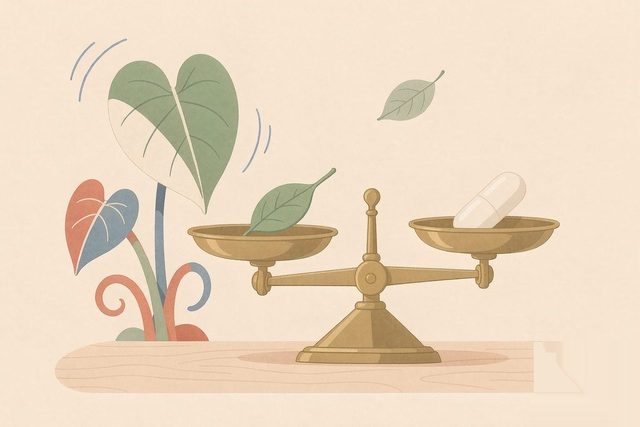
The table is a map of uncertainty, not a verdict. Both ingredients remain legitimate research subjects. The honest problem is that product labels often borrow more certainty than the trials provide.
What human studies actually measure
Saw-palmetto trials commonly use the International Prostate Symptom Score (IPSS). That is a questionnaire covering seven urinary symptoms. Trials may also measure peak urinary flow, nighttime urination, prostate volume, or the need for more treatment. These are different endpoints. A small change in a symptom score over several weeks does not show that the prostate became smaller. It does not show that obstruction was corrected. And it does not show that complications were prevented.
The evidence for saw palmetto is mixed. Early, small studies sometimes reported symptom improvements. Larger placebo-controlled trials using commonly available doses have often found little difference from placebo. Reviews also point to wide variation in extraction methods, fatty-acid content, dose, follow-up, and outcome reporting. The National Center for Complementary and Integrative Health (NCCIH) summarizes the current uncertainty. It does not describe saw palmetto as a reliably effective treatment for BPH symptoms. Results from one extract cannot automatically be applied to every softgel or powder.
Beta-sitosterol has been evaluated in men with urinary symptoms. Some controlled trials and systematic reviews report better symptom scores or urinary flow than placebo, particularly over short follow-up periods. Those studies generally do not establish a smaller prostate. Nor do they prove that beta-sitosterol prevents acute retention, surgery, or long-term disease progression. Older trials may also have small samples and different sterol formulations. Evidence for a standardized research preparation is not evidence for an unspecified proprietary blend.
Reading a product label critically
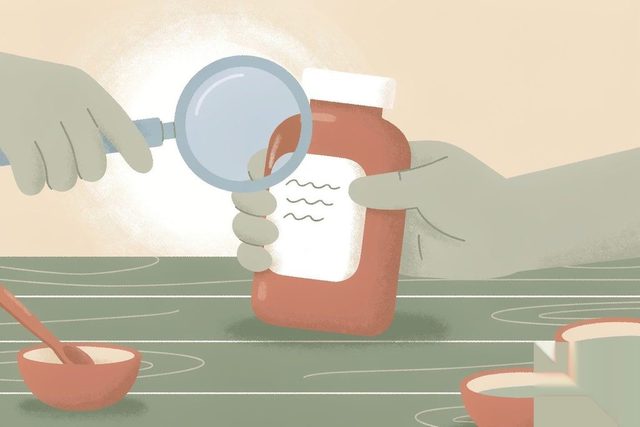
Start with the identity of the ingredient. For saw palmetto, look for the botanical name. Check whether the material is a fruit extract, how it is standardized, and the amount per serving. Some labels state a fatty-acid percentage. Others provide only total extract weight. These figures are not automatically equivalent. For beta-sitosterol, check whether the quantity is beta-sitosterol itself or “total plant sterols.” That second figure may include other compounds.
Record the serving size, daily servings, other active ingredients, lot or expiration information, and any independent quality testing. A proprietary blend that lists only a combined weight prevents comparison with a clinical study. Added minerals or herbal extracts can also change a formula’s safety and interpretation. Third-party testing may address identity or contamination. It does not prove a symptom effect.
A quick way to pressure-test any product page: find the specific study it cites, then check three fields — extract type, daily amount, and duration. If any of the three does not match the product, the citation supports the study, not the bottle. We use the same field-matching discipline in commercial evaluations such as the PotentVital review (check its current terms). The men’s health hub places both ingredients in their wider category context.
Safety and evidence boundaries
NCCIH describes saw palmetto’s reported adverse effects as generally mild and infrequent. They include digestive symptoms, dizziness, and headache. Discuss any supplement with a qualified clinician when you take medicines. A label cannot rule out interactions. Beta-sitosterol’s long-term safety was not established in the reviewed urinary-symptom trials. Short follow-up and similar withdrawal rates do not demonstrate safety for every dose, combination, or medical condition.
Neither ingredient has a universal dose supported across all products. “Clinically studied” is meaningful only when the extract, amount, comparator, population, duration, and endpoint are identified. A marketing phrase such as “supports healthy prostate function” can cover a much broader claim than the trial’s measured outcome. Testimonials, search snippets, and mechanistic explanations are not substitutes for randomized human evidence.
Frequently asked questions
Is saw palmetto useless, then? Not a fair conclusion. The evidence is mixed and preparation-specific — some trials report signal, larger ones often do not, and extract types vary. The honest position is uncertainty, not dismissal or endorsement.
Does beta-sitosterol shrink the prostate? Studies of urinary symptoms and flow have not established a reduction in prostate size or prevention of disease progression. Symptom measures are not the same as disease modification.
Should I stop taking one of these before surgery? Always raise this with your surgical team. Supplement use before a procedure is a standing professional-consultation topic. It is not something to decide from an article.
Can these ingredients replace prescription BPH medicine? No. Prescribed treatments come with monitoring and established trial programs. Never stop or substitute prescribed medicine based on marketing or an article.
Balanced interpretation
Saw palmetto and beta-sitosterol remain reasonable subjects for evidence review, but the available findings are preparation-specific and limited. Saw palmetto results are particularly inconsistent, while beta-sitosterol findings mainly concern short-term urinary symptom measures rather than disease modification. A complete label can reveal whether a product resembles a studied preparation; it cannot establish efficacy by itself. Persistent or worsening urinary symptoms should be evaluated for an underlying cause, and medication or health conditions should be considered before adding either ingredient.
Sources and access dates
- NIH National Center for Complementary and Integrative Health, “Saw Palmetto.” Official evidence and safety overview, including the uncertainty of BPH findings: https://www.nccih.nih.gov/health/saw-palmetto (accessed October 9, 2026).
- NIH National Institute of Diabetes and Digestive and Kidney Diseases, “Enlarged Prostate (Benign Prostatic Hyperplasia).” Official description of symptoms, differential considerations, and clinical evaluation: https://www.niddk.nih.gov/health-information/urologic-diseases/prostate-problems/enlarged-prostate-benign-prostatic-hyperplasia (accessed October 9, 2026).
- PubMed Central, “Beta-sitosterols for benign prostatic hyperplasia.” Systematic review record covering randomized trials, urinary endpoints, and evidence limitations: https://pmc.ncbi.nlm.nih.gov/articles/PMC8407049/ (accessed October 9, 2026).
- PubMed, “beta-sitosterol for the treatment of benign prostatic hyperplasia: a systematic review.” Primary bibliographic record for the review of four randomized trials: https://pubmed.ncbi.nlm.nih.gov/10368239/ (accessed October 9, 2026).
Related notes
→ Heart, Circulation and Men’s Health Supplements Compared
→ Top Blood Flow and Nitric Oxide Formulas for Men
→ Early Signs of Peripheral Circulation Problems
Facts checked: 9 October 2026 · VitalRoundup Editorial Team · Reviewed by VitalRoundup Editorial Team (sources and label data re-checked) · How we review