ColestZen — sometimes written Colest Zen — is sold as a daily capsule for cholesterol, heart health and blood-sugar support. It names eighteen ingredients — nine botanicals and nine micronutrients — and publishes an amount for none of them.
And it has a second problem we’ve never seen stated plainly anywhere else: the scientific reference list on the page cites studies for ingredients that aren’t in the formula. All fifteen of them. That took about twenty minutes to verify, and it’s the most checkable thing on the entire page.

Quick answer
An 18-ingredient proprietary blend with no published amounts, priced at $49–$79 a bottle with a 60-day refund window. The refund terms are solid; the label tells you nothing you can compare against research, and the page's own citations don't match its formula.
- Eighteen ingredients are named — nine botanicals, nine vitamins and minerals. Not one carries an amount in mg, mcg or IU.
- The page cites 15 scientific studies. The ingredients in those studies (arjuna, amla, camu-camu, pycnogenol, sea buckthorn, and others) appear nowhere in the 18-ingredient formula.
- The customer testimonials on the page include specific medical numbers — 'LDL dropped by 35 points', 'my doctor reduced my meds' — which are claims, not evidence.
Skip it if you take a statin, blood-pressure medication or diabetes medication and are hoping a supplement can take over any part of it. Cholesterol management has a real, well-studied treatment baseline; nothing on this page changes that.
Product overview
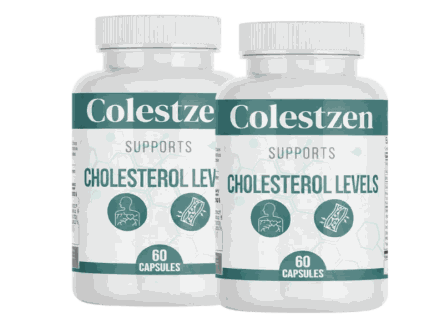
ColestZen
An 18-ingredient capsule sold as cholesterol, heart and blood-sugar support.
- Format
- Capsule, two daily
- Sold as
- Cholesterol and cardiovascular support
- Ingredients named
- 18
- Amounts published
- 0
ColestZen review snapshot
Eighteen ingredients named; zero amounts published
Citations reference ingredients that aren't in the formula
$49 per bottle on the best displayed tier
60-day refund, empty bottles accepted, no auto-ship
Testimonial LDL and blood-pressure numbers; unverifiable media wall
Our verdict: Fully named ingredient list with no quantities, unusually good refund terms, and a citation list that undermines the page's own credibility.
Secure checkout · Verify the current price and refund terms on the order page.
Product image: manufacturer-supplied promotional asset, reproduced as shown on the vendor's own page.
What we checked, and how
Three things here are measurements rather than opinions, so it’s worth saying exactly how each was made.
The ingredient list comes from the manufacturer’s own sales page. We counted what’s named and what carries a stated amount. Our rule across this site is the same one we apply everywhere: what the page publishes, we report; what it doesn’t, we say is absent.
The amount check was done by searching the full rendered text of the sales page for dosage units — “mg”, “mcg”, “IU”, “CFU”, or any number followed by a unit. The result: zero occurrences anywhere on the page. The blend is described only as “optimally dosed, proprietary” — which is a description, not a measurement.
The reference check was a cross-read. We listed the ingredients in the 15 cited studies, then searched the page for each of those ingredient names outside the reference section. Arjuna, amla, camu-camu, pycnogenol, centella, sea buckthorn, schisandra, rhodiola, astaxanthin and epicatechin appear exactly once each on the page — inside the citations themselves. None is in the formula.
The prices and terms were read from the order section of the same page, not from a review site.
One note on scope: we review the label, the claims and the offer. We don’t run trials, and we don’t read a testimonial as evidence — a distinction the page we’re reviewing leans on heavily.
What’s actually in it
Straight from the label, in their order. First the nine botanicals:
Bitter melon extract (fruit) · Cinnamon (bark) · Licorice extract (root) · Gymnema sylvestre (leaf) · Banaba extract (leaf) · Mulberry fruit powder · Yarrow herb powder · Cayenne pepper extract · Juniper berry powder
Then what the page calls “The 9 Silent Defenders”:
L-taurine · Alpha lipoic acid · Vitamin C · Vitamin E · Biotin · Magnesium · Zinc · Manganese · Chromium
Two observations that don’t require any expertise:
- Six of the nine botanicals are blood-sugar ingredients, not cholesterol ones. Bitter melon, cinnamon, gymnema, banaba, mulberry and chromium (in the mineral layer) are recognisably glucose-directed. The page itself concedes this — most of its ingredient blurries say “blood sugar” first. If you came for cholesterol specifically, the formula’s centre of gravity is elsewhere.
- One ingredient makes the missing amounts matter more than usual: licorice. Licorice root contains glycyrrhizin, which at sufficient intake is well documented to raise blood pressure and lower potassium. That’s an effect driven almost entirely by dose — and this is the one label that doesn’t publish one.
The nine botanicals, briefly
What follows is what the published literature says about each ingredient on its own — not about this capsule.
Bitter melon has small human trials in type 2 diabetes with mixed results. The studies are short and the preparations vary. It is not a cholesterol ingredient.
Cinnamon is the best-studied item here, with trials and meta-analyses examining fasting glucose and lipids in type 2 diabetes. Effects are modest and inconsistent between studies, and dose and species (cassia vs. Ceylon) matter — none of which this label specifies.
Licorice is a traditional digestive and respiratory herb. Its cardiovascular relevance is the glycyrrhizin issue above — a reason for caution, not support.
Gymnema sylvestre is the page’s “sugar blocker.” It has small trials in type 2 diabetes reporting changes in fasting glucose. The “blocks sugar absorption” framing goes beyond what those studies showed.
Banaba (corosolic acid) has small studies on glucose metabolism that haven’t been reproduced at scale.
Mulberry has some human data on post-meal glucose response, mostly from the leaf — this label says fruit powder.
Yarrow, cayenne and juniper appear in traditional-medicine literature rather than in cholesterol or metabolic trials. For the claims on this page, there’s essentially nothing to cite.
The nine micronutrients
Vitamins C and E are antioxidants; magnesium and zinc are essential minerals; chromium participates in insulin signalling; alpha lipoic acid is studied at doses from several hundred mg upward, mostly for diabetic neuropathy; biotin, manganese and taurine round out the list. Every one of these is a real nutrient. None of it answers the question that matters here: how much? A multivitamin and this capsule could share the same nine names and be completely different products, and the label gives you no way to know which you’re looking at.
The evidence, ingredient by ingredient
This is where “named but not quantified” becomes concrete.
| Ingredient | Evidence | What it actually means |
|---|---|---|
| Cinnamon (bark)Supports blood sugar already in normal range, balanced heart function | Limited | Trials and meta-analyses exist for fasting glucose in type 2 diabetes, with modest and inconsistent lipid effects. Species and dose matter, and this label states neither. |
| Gymnema sylvestreSugar blocker; supports blood sugar | Limited | Small trials in type 2 diabetes report fasting-glucose changes. The 'blocks sugar' framing outruns them, and the amount per serving is unpublished. |
| ChromiumRestores insulin sensitivity, prevents sugar becoming cholesterol | Limited | Chromium's glucose role is real but its trial record is mixed, and results depend on form and dose. The 'sugar into cholesterol' claim has no trial base on this label. |
| Alpha lipoic acidProtects cardiovascular tissues, supports insulin sensitivity | Limited | Studied mainly for diabetic neuropathy at doses from several hundred mg upward. Dose is the whole question, and this label doesn't publish one. |
| Bitter melon extractGlucose control and cardiovascular wellness | Weak | Small, short, mixed human trials in diabetes. No meaningful human evidence for the cardiovascular claim. |
| Banaba extractSupports glucose metabolism and insulin activity | Weak | Small corosolic-acid studies that haven't been reproduced. Amount unpublished. |
| Yarrow, cayenne, juniper, mulberry, licoriceCirculation, detox and digestive support | Weak | Traditional-use ingredients with little to no trial base for cholesterol or metabolic outcomes. Licorice additionally carries a dose-dependent blood-pressure concern. |
Grades reflect the strength of published human evidence for the ingredient in this context — not the quality of the ingredient itself. Where a claim is unproven rather than disproven, we say so.
The marketing page, examined
Some of what’s on this page is worth knowing about before any purchase, because it shapes how the offer feels.
The testimonials carry medical numbers. “LDL dropped by 35 points in just two months.” “LDL down 42 points, blood pressure back in range.” “My doctor reduced my meds.” These are unverified anecdotes presented beside a five-star widget counting “12,785 verified reviews” — a number with no way to check it. Testimonials aren’t evidence in any direction, but specific clinical numbers attributed to a supplement are the exact pattern health regulators warn consumers about.
The scarcity devices. The page shows a countdown timer and a stock bar reading “Only 47 bottles remaining — 23% left.” In the page’s own code, that bar’s width is set to a fixed 23% with an animation attached. It isn’t measuring anything.
The media wall. “As Featured In” is followed by the names of five well-known health publications, rendered as styled text rather than actual logos. We can’t verify that any of them has featured this product, and the page offers no links to check.
The citation list. Covered above, and worth repeating because it’s the most unusual finding: fifteen studies are cited, and the ingredients in them don’t appear in the formula.
Price and terms
Read from the order section of the manufacturer’s page:
| Package | Supply | Price | Shipping | Per bottle |
|---|---|---|---|---|
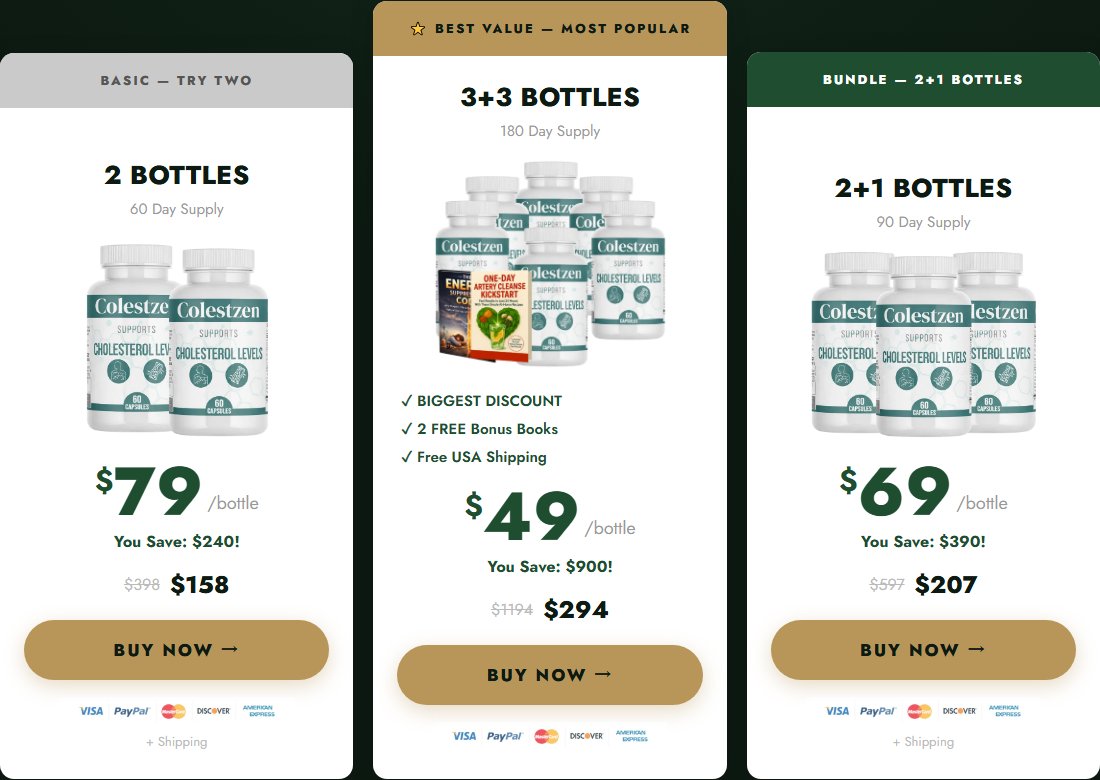
| Basic — 2 bottles | 60 days | $158 | + shipping | $79 |
| Bundle — 2+1 bottles | 90 days | $207 | + shipping | $69 |
| Best value — 3+3 bottles | 180 days | $294 | Free (US) | $49 |
Terms that are genuinely better than average:
- 60-day money-back guarantee. The page states empty bottles are accepted for refund, which is a stronger formulation than most “we reserve the right to judge your return” policies.
- One-time payment, no auto-ship. Their FAQ states the order has no recurring billing or hidden charges — rarer in this category than it should be, and the single most common complaint pattern elsewhere.
The two bonus books are attached to the six-bottle order only. The retailer of record is BuyGoods, which processes payments and refunds under its own buyer-protection terms.
ColestZen against the category’s common baseline
The baseline below describes practices common across direct-to-consumer supplement sales pages in this category — not any specific competitor. It is a terms-and-transparency comparison, not an effectiveness ranking.
| Dimension | Category common practice | ColestZen as reviewed |
|---|---|---|
| Ingredient disclosure | Names only, or partial amounts | 18 ingredients named, zero amounts (proprietary blend) |
| Dose matching to studies | Rarely possible | Not possible |
| Refund window | 30 days is typical | 60 days, stated, empty bottles accepted |
| Auto-ship / recurring billing | Frequent complaint pattern | Stated one-time payment, no auto-ship |
| Anchor pricing (struck-through totals) | Common | Present ($398/$597/$1,194 shown struck) |
| Scarcity devices | Common | Countdown timer + fixed-width stock bar |
| Citation quality | Often vague | 15 studies cited; ingredients don’t match the formula |
The same split as GutSave shows up here: purchase terms well above the category baseline, disclosure and citation quality below it. The fixed-width stock bar and non-matching citations are the two details a buyer should weigh most heavily, because they concern the information you’d rely on rather than the price you’d pay.
Opens the manufacturer's own order page. Confirm the price, shipping and refund window there before ordering — they change.
Sold via BuyGoodssecure checkout60-day money-back guaranteeaffiliate link · we may be paid · the price you pay is unchangedOur scoring
Weak
Fully named ingredients, unusually good refund terms, and two transparency failures — no amounts, and a citation list pointing at a different formula. Not a scam — but not checkable either.
| Ingredient transparencyEighteen ingredients named, zero amounts published | 1.5 |
|---|---|
| Evidence alignmentThe cited studies' ingredients aren't in the formula | 2.0 |
| Value for money$49 per bottle on the best tier — mid-category | 3.0 |
| Purchase terms60-day refund, empty bottles accepted, no auto-ship | 4.0 |
| Claim accuracyTestimonial LDL numbers, animated stock bar, unverifiable media wall | 1.5 |
What works
- All 18 ingredients are named individually — nothing is hidden behind a vague 'blend' label even though no amounts are given.
- 60-day money-back window with empty bottles accepted, longer than the 30 days most competitors give.
- One-time payment with no auto-ship, confirmed in the manufacturer's own FAQ.
- Free US shipping on the six-bottle order, and the stated retailer (BuyGoods) adds its own buyer-protection layer.
What doesn't
- No quantities published for any of the eighteen ingredients — no mg, no mcg, no IU, nothing.
- The page's 15 scientific citations reference ingredients that don't appear anywhere in the formula.
- Testimonials attribute specific LDL and blood-pressure changes to the product — claims, not evidence.
- The stock bar ('only 47 bottles remaining') is a fixed-width animation, not a measurement.
- An 'As Featured In' media wall with no links and no way to verify.
- Licorice extract is unquantified — an ingredient whose main known risk is dose-dependent.
- The single-bottle equivalent is expensive at $79, which pushes you toward a large upfront order.
Who it suits, and who should skip it
It’s a reasonable look if you’ve already worked through the basics your clinician actually endorses, you want a two-capsule daily habit, and you value the refund window. The 60-day guarantee with empty bottles accepted means the financial downside is limited to return shipping if it doesn’t suit you.
Skip it if you take a statin, a blood-pressure medication or diabetes medication — not because the capsule will interfere with them necessarily, but because you can’t know the doses, and cholesterol management is exactly the area where replacing or layering something unquantified on top of prescribed care is a clinician’s decision. Take a pass as well if you’re pregnant, or if you have hypertension or low potassium, since the licorice content is unquantified.
And it’s the wrong purchase entirely if the testimonials moved you. Specific LDL numbers in anonymous anecdotes are the least checkable claims on the whole page — which, on a page where the citations don’t match the formula, is saying something.
The bottom line
ColestZen isn’t a scam. It’s a real product with genuinely good purchase terms and a retail layer that will process a refund.
The thing to understand before you buy is the asymmetry, and on this page it’s unusually lopsided: the terms are checkable and they’re good; the formula isn’t checkable at all — and the page’s own reference list quietly admits it by citing studies for ingredients the capsule doesn’t contain. Whether that trade is acceptable is your call — but now you’re making it with the same information we had.
How VitalRoundup rates supplements
Every score on this site comes from the same five checks. None of them measure whether a product "works" as a treatment — that is a clinical question we do not answer. They measure how verifiable, fairly priced, and honestly presented the product is.
- Ingredient transparency. Are amounts — in mg, mcg, or CFU — printed on the label, or hidden in a blend?
- Evidence alignment. Does the published human research actually point at this stated use?
- Value for money. What you pay versus what is verifiably in the bottle.
- Purchase terms. Refund window, auto-ship, and subscription clarity.
- Claim accuracy. Do the marketing claims exceed what can be independently checked?
| Score | Meaning |
|---|---|
| 4.5–5.0 | Excellent |
| 3.5–4.4 | Good |
| 2.5–3.4 | Mixed |
| 1.5–2.4 | Weak |
| 0.0–1.4 | Poor |
We are an editorial team, not a clinic. Our reviews are general educational information, not diagnosis or treatment, and they are not a substitute for advice from your own qualified clinician.
References
Frequently asked questions
Is ColestZen a scam?
Where can I read real Colest Zen reviews?
Does ColestZen lower LDL cholesterol?
How much of each ingredient does ColestZen contain?
Can ColestZen replace my statin?
Is ColestZen safe?
What is the refund policy?
Related notes
→ Heart, Circulation and Men’s Health Supplements Compared
→ Blood Sugar and Cholesterol Supplements Compared: An Evidence-Led Hub
→ Cholesterol Support Supplements: An Evidence and Label Guide
→ Berberine for blood sugar: what the clinical evidence actually shows
→ Foods that spike blood sugar, and what actually stabilises it
→ PotentVital Review: another formula we checked in this cluster
Independent product research
We compare publicly documented ingredient lists, official pricing pages and verified customer reports. We do not accept payment for reviews and we do not publish claims a product's own manufacturer cannot substantiate.
Facts checked: . How we review
Reviewed by VitalRoundup Editorial Team — sources and label data re-checked. Review standards